New — check if your vessel can carry more deadweight Carry more deadweight? Try it →

ShipLCOM 3.0 — Loading Instrument / Loadmaster

The loading computer built by naval architects.

ShipLCOM reproduces, for any loading condition the master builds, the same calculations that are contained in the ship's approved trim and stability booklet — and answers immediately whether the condition is acceptable. The loading instrument, or load master, the crew works with every day.

Already using ShipLCOM? Watch the video tutorials in the customer area.

2003first delivery
250+ships worldwide
8class societies
3.0current release
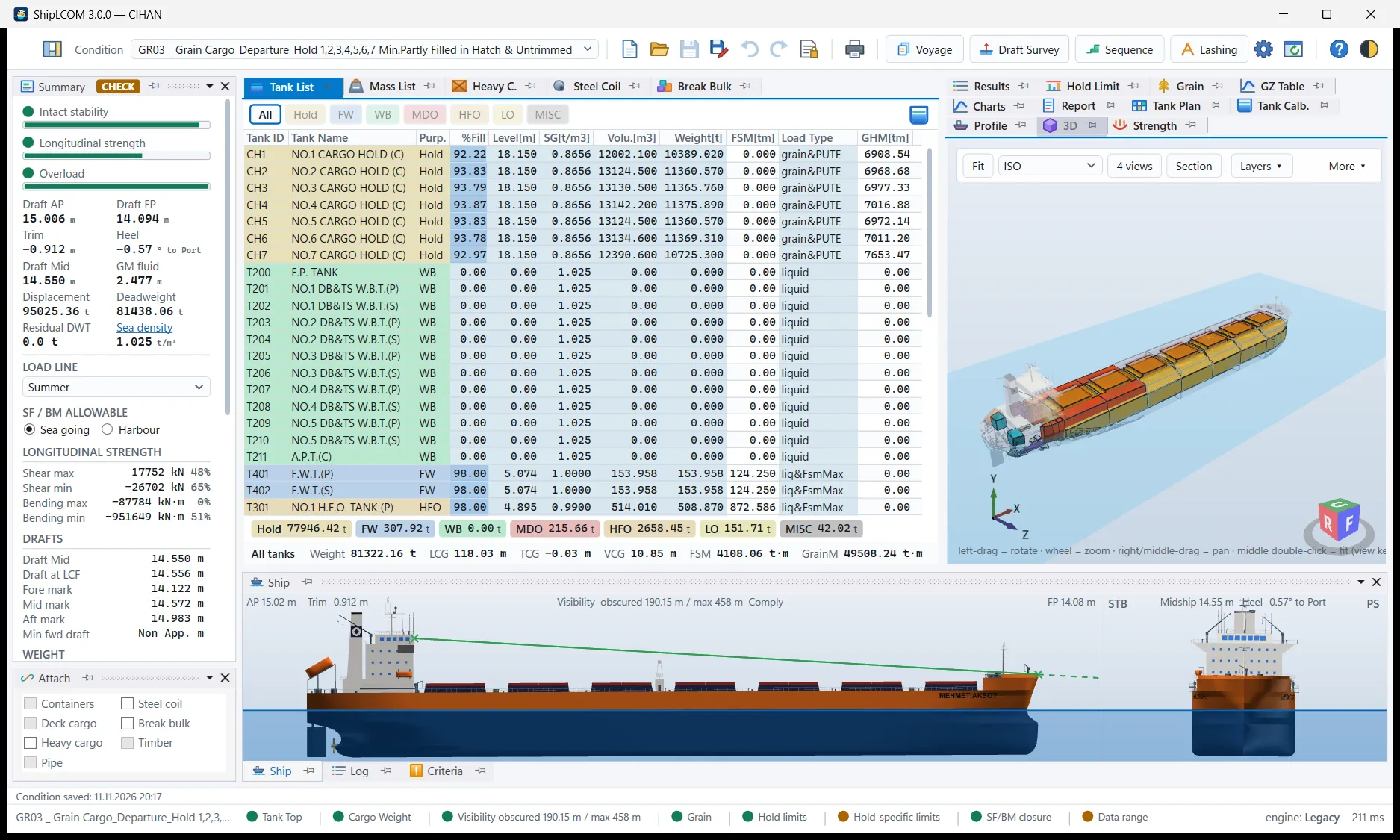
ShipLCOM 3.0 main window — a bulk carrier loaded with grain: summary, tank list, the ship in 3D and the Ship band with the vessel floating at her drafts
Intact Stability

Every criterion of the selected stability code passes — areas under the GZ curve, GM, maximum GZ and the weather criterion.

Longitudinal Strength

Shear force and bending moment inside the class limits at every station, on harbour or seagoing envelopes.

Overload Check

The draft stays within the load line of the selected seasonal zone.

Visibility

The blind sector ahead of the bridge stays within the SOLAS limit — recalculated the moment deck cargo is attached.

The criteria strip above every loading screen adds tank top strength, the cargo weight limit of each hold, heel and — where installed — damage stability, and sums everything up in a single SAFE / NOT SAFE verdict for the condition.

Modules

Everything the condition has to pass, in one program.

Modules follow the trade of the vessel — bulk carriers, general cargo and multipurpose ships, container feeders, steel and project cargo carriers, tankers.

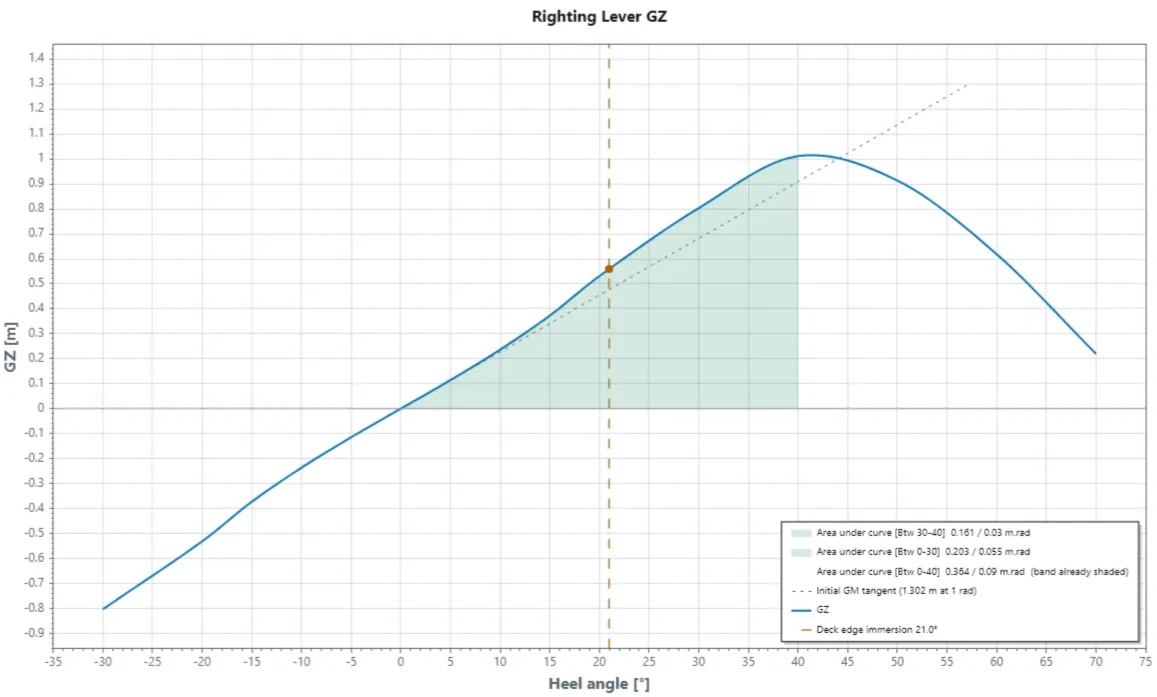
Righting-lever GZ curve with the initial GM tangent, shaded criteria areas and the deck-edge immersion angle
Results

Intact stability & weather criterion

GZ curve with the initial GM tangent, the criteria areas shaded and the deck-edge immersion angle marked; every rule of the selected code — 2008 IS Code, grain, timber or a ship-specific set — listed with its actual value, its limit and PASS / FAIL. The severe wind and rolling criterion is evaluated with the real lateral silhouette, including attached deck cargo.

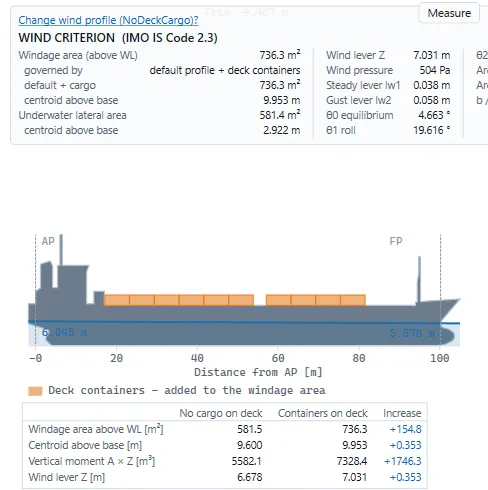
Weather criterion panel with the wind profile, deck containers added to the windage area and the increase table
Results

Weather criterion & wind profile

The IS Code 2.3 weather criterion laid out on the Profile page: windage and underwater lateral areas, wind pressure, the steady and gust heeling levers and the roll angles. Deck containers and deck cargo are added to the wind profile in their own colour, with the windage area, centroid and wind lever before and after the cargo is loaded.

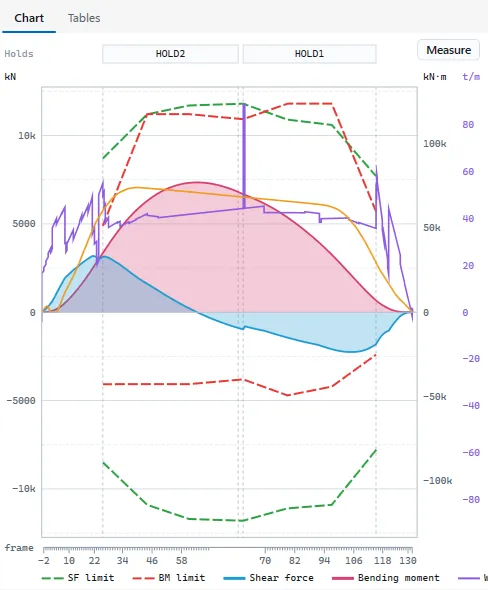
Strength chart — shear force and bending moment with weight and buoyancy against the allowable envelopes
Results

Longitudinal strength (BM / SF)

Still-water shear force, bending moment, weight and buoyancy in one chart against the allowable envelopes, with sea-going or harbour limits and the value under the cursor. Peaks are listed both as absolute values and as a percentage of what is allowed at that frame — the figure that actually decides the condition. Heavy and deck cargo are carried into the hull girder through their dunnage supports.

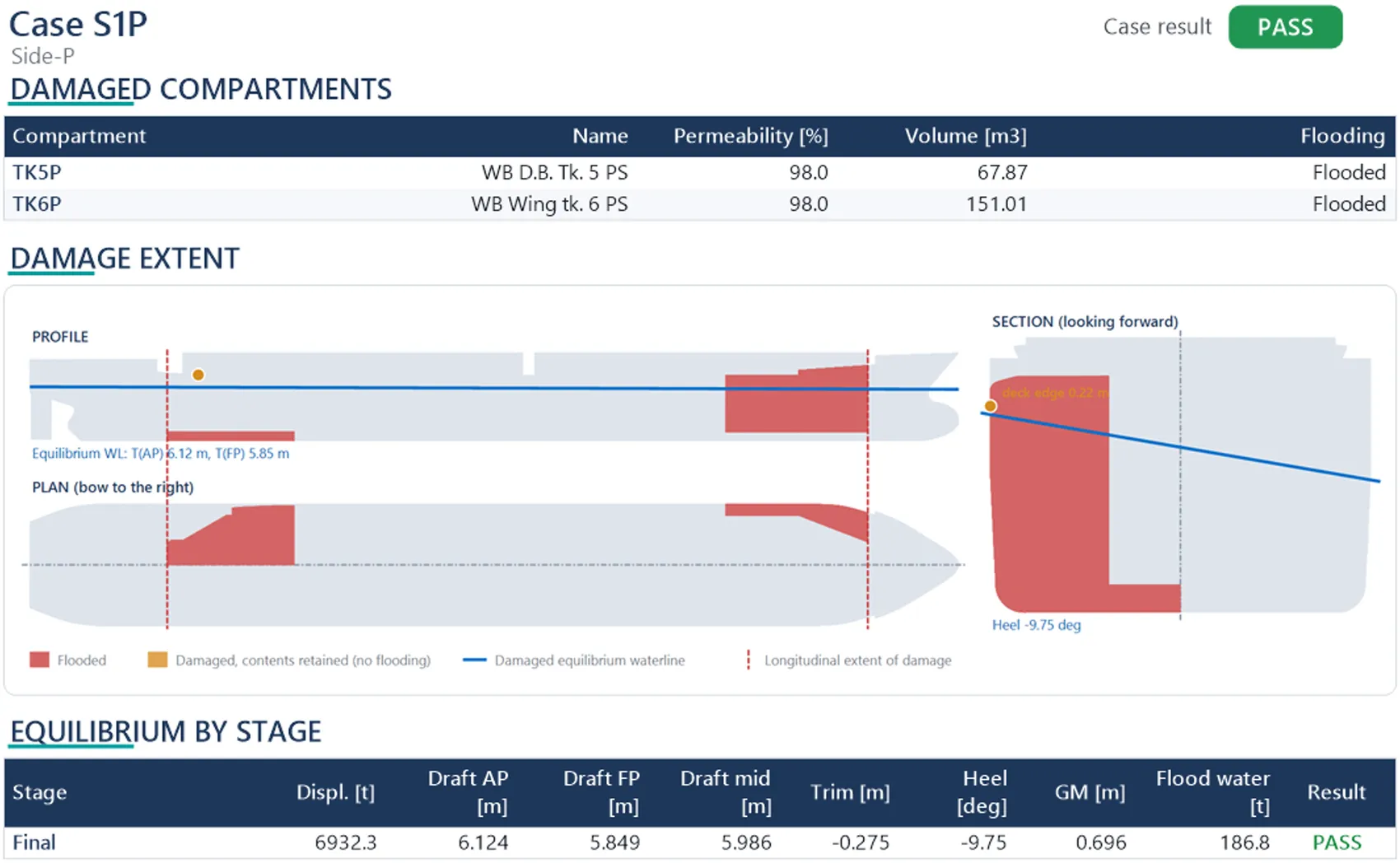
Damage case report page — flooded compartments, damage extent in profile, plan and section, and the equilibrium by stage
Results

Damage stability

The approved damage cases of the ship, flooded by the lost-buoyancy method — optionally balanced directly on the 3D hull. Each case shows the flooded compartments, the damage extent in profile, plan and section, the equilibrium floating position, residual GZ and the applicable criteria set (SOLAS 2009, MARPOL, MSC.235(82) or the IACS UR S17 flooded-hold strength check), with a report page per case.

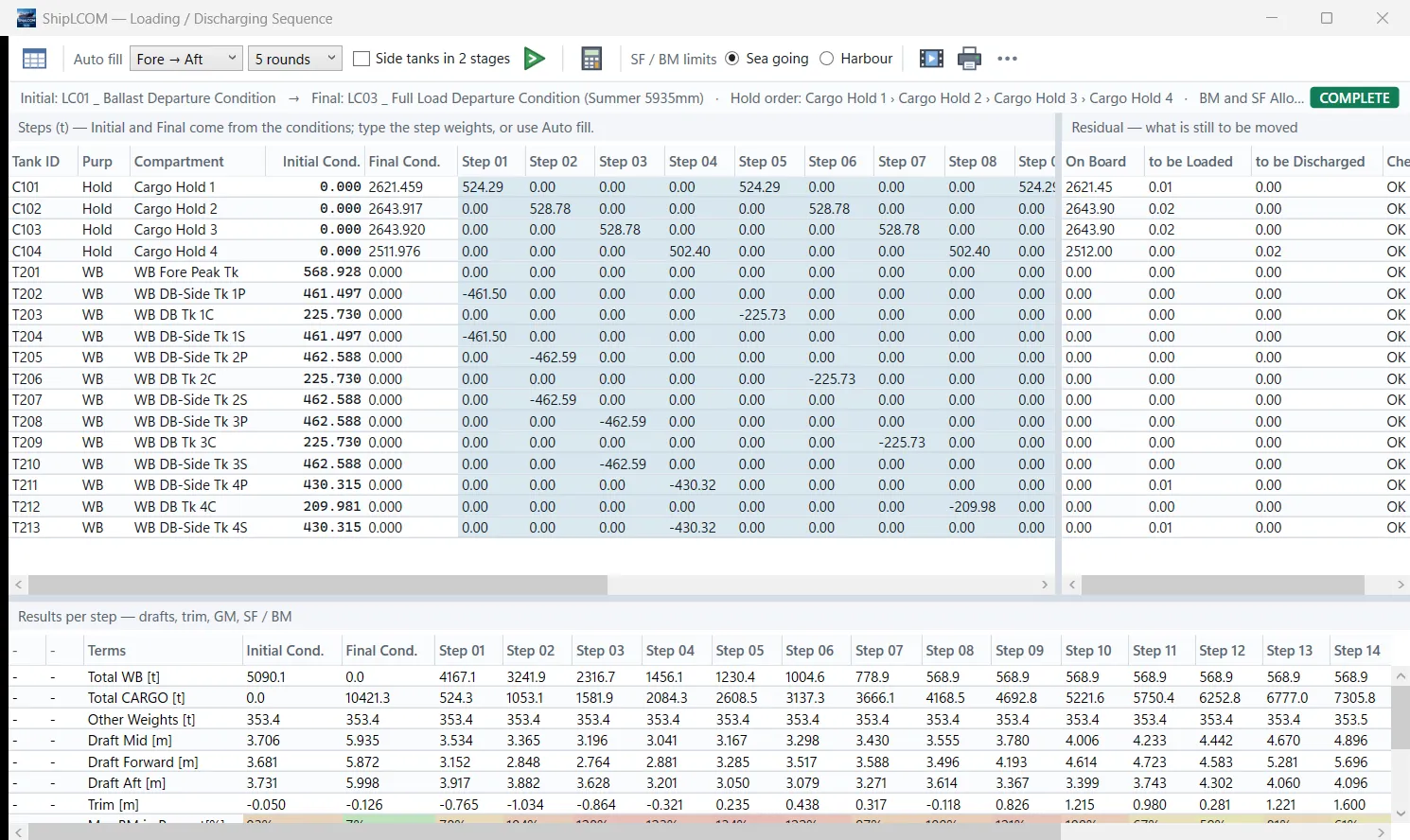
Loading sequence window — step matrix from ballast to full load, residual cargo and the results per step
Operations

Loading / unloading sequence

The cargo operation planned as steps between the initial and the final condition — filled automatically fore-to-aft or aft-to-fore in a chosen number of rounds, or typed in — with drafts, trim, GM and the BM / SF percentages calculated at every stage — because the highest bending moment usually occurs between the ballast and the loaded condition, not at the end. Intermediate steps are checked against the harbour limits, and Smart auto fill chooses the hold and the ballast of each step by trim and strength. The plan can be agreed with the terminal before loading starts.

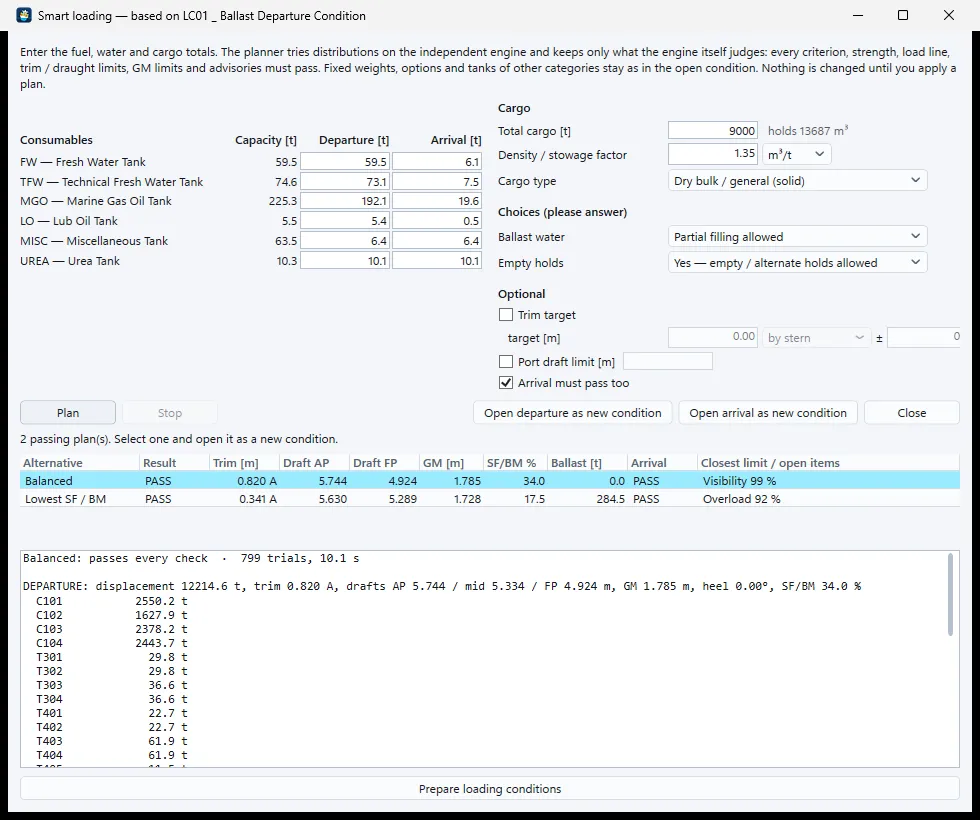
Smart loading window — cargo and consumables entered, two passing plans with trim, drafts, GM and SF / BM
Planning

Smart loading

Enter the fuel, water and cargo totals with the stowage factor, and say whether ballast and empty holds are allowed. The planner tries distributions on the program’s own engine and keeps only plans that pass every check — stability, strength, load line, draughts, visibility and hold limits — offering a balanced, a least-ballast and a lowest SF / BM alternative. The departure and arrival conditions are saved in one step. An optional module; the master stays responsible for the condition.

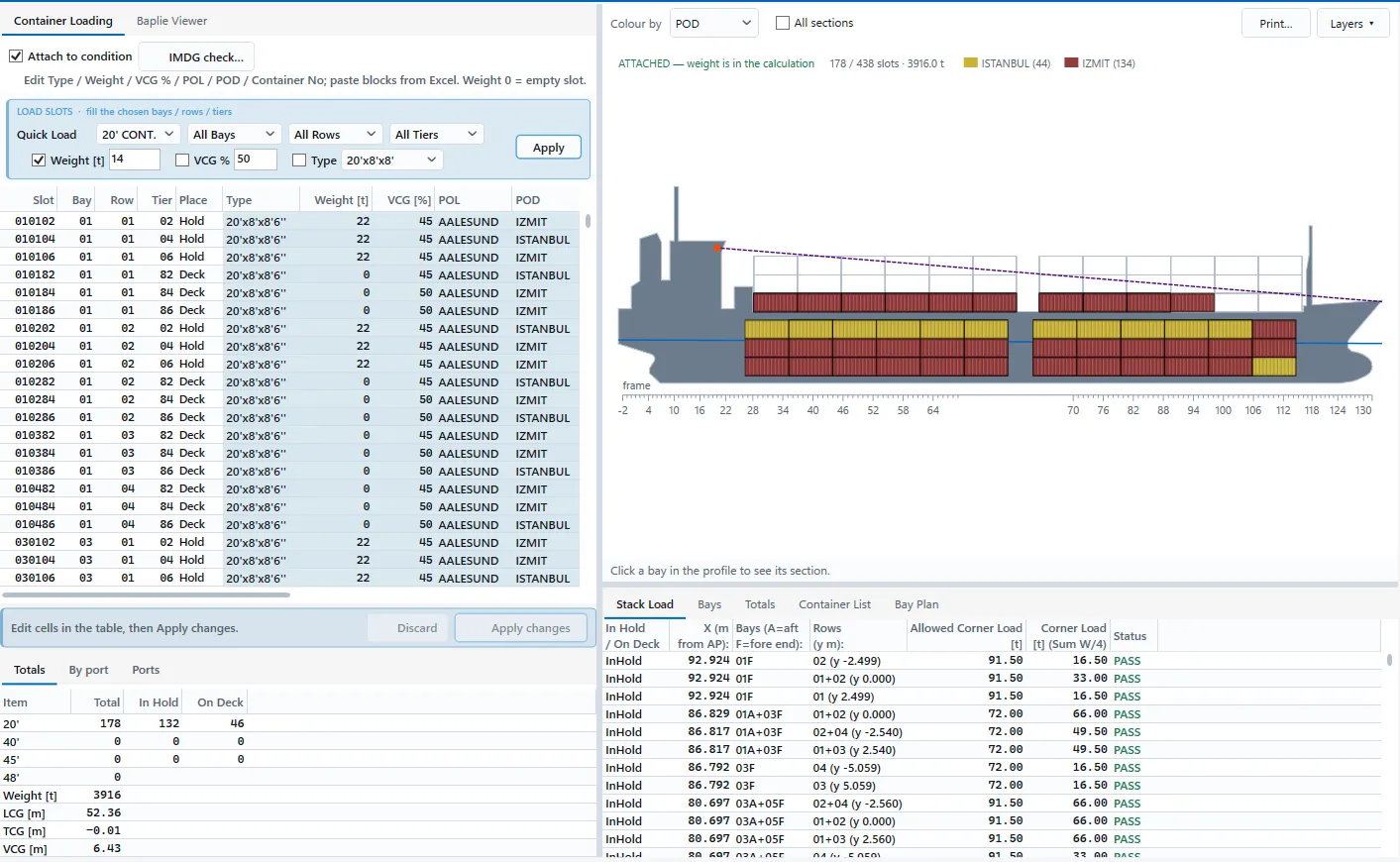
Container Loading page — slot list, profile coloured by port of discharge with the visibility line and the corner load check
Cargo

Containers & BAPLIE

Container Loading with a slot list by bay / row / tier and Quick Load, the profile and the 3D view coloured by port of discharge, the stack load check per corner and IMDG segregation. A separate Baplie Viewer reads incoming BAPLIE files, and the stow is exported again as BAPLIE. The deck stow enters the visibility check and the wind profile the moment it is attached.

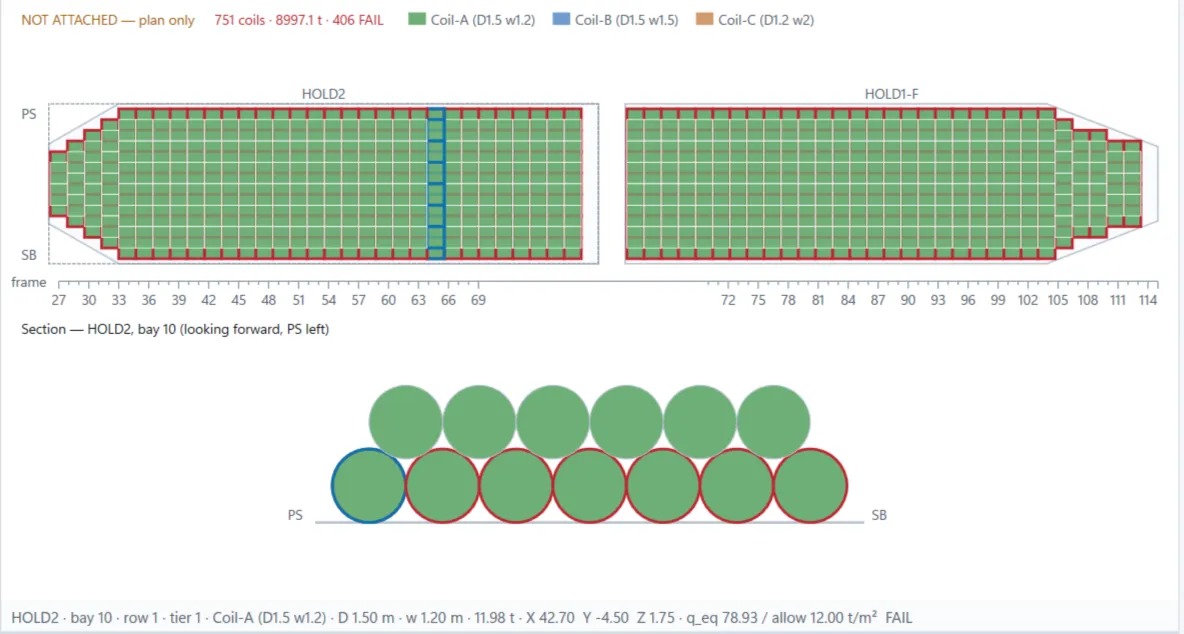
Steel coil module — coils stowed in two holds in plan view, a bay in section and the tank top check per coil
Cargo

Steel coil & tank top strength

Coils stowed bay by bay and tier by tier, with dunnage, drawn in plan and in section. The pressure each coil puts on the tank top is checked against the permissible load of the hold, and every coil over the limit is outlined. Deck cargo, break bulk, heavy cargo, timber and pipe have their own 3D loaders on the same pattern.
Beyond the loading case

From the 3D model to the signed report.

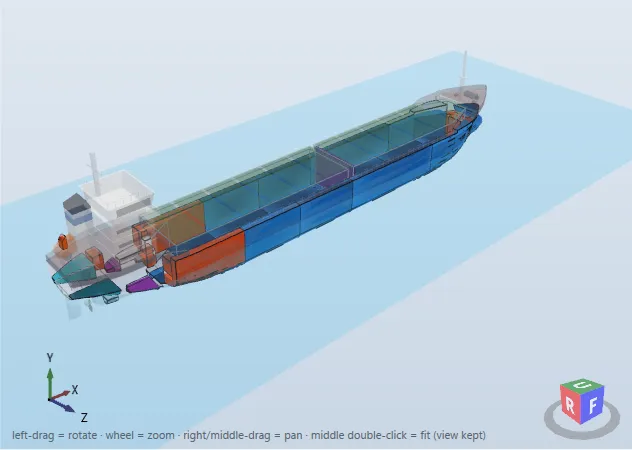
3D view of the hull, the cargo holds and tanks at their current level, on the waterline plane
Tools

3D model of hull, tanks and cargo

The hull, every tank at its current level and the attached cargo in three dimensions — with hydrostatics computed directly from the geometry, an eye view from the conning position for the visibility check, and volume and mesh checks for new ship data. The Ship band under every screen shows the vessel floating at her drafts, trim and heel, with the line of sight from the bridge.

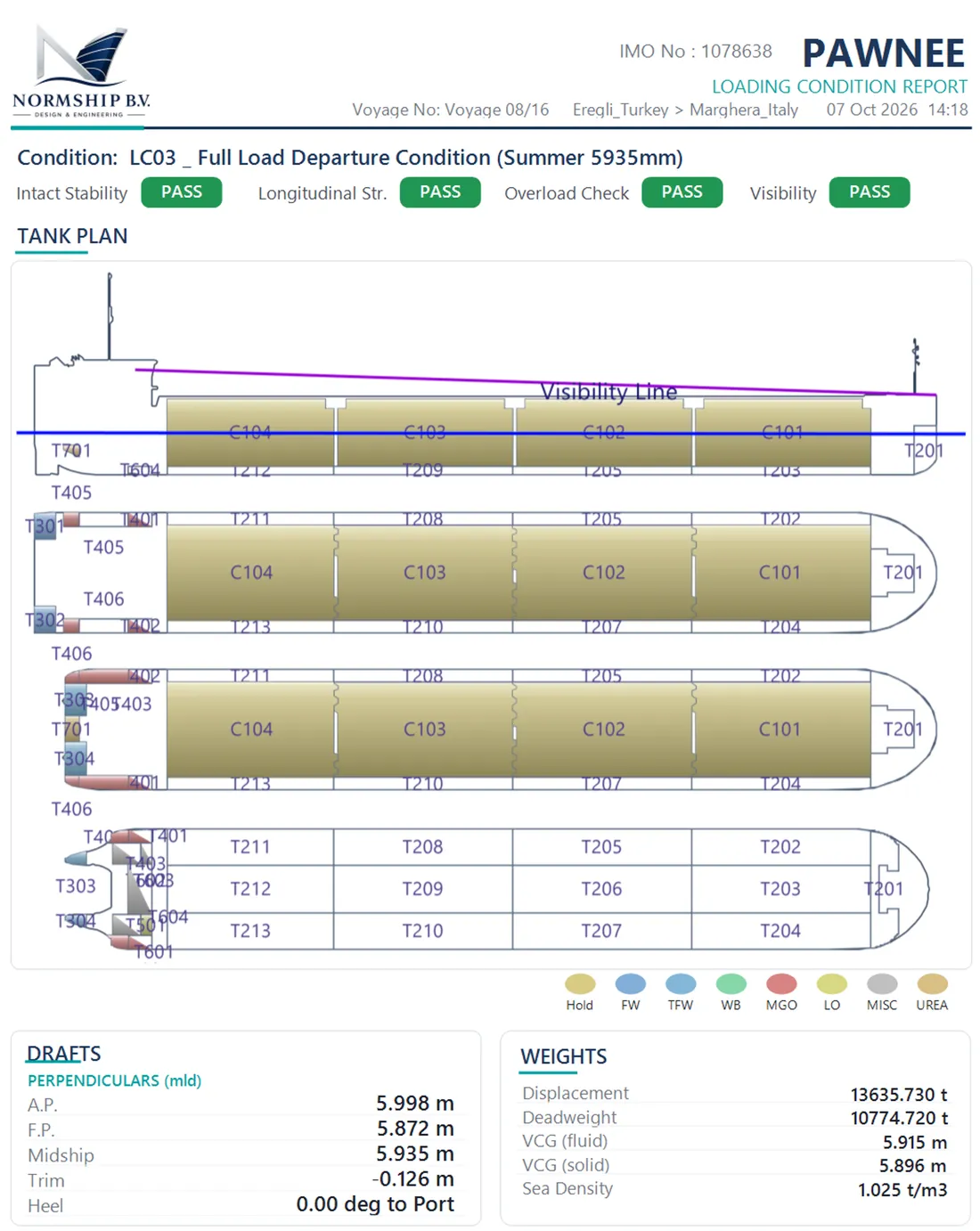
First page of the loading condition report — voyage, the four verdict badges, tank plan, drafts and weights
Reports

Class-ready documents

The loading condition report, a damage stability report with one page per case, the grain form, the securing calculation, draft survey and calibration tables — as vector PDFs with sharp, selectable text. The Test Case Booklet and a complete Addendum Intact Stability Booklet are generated from the conditions themselves. The first page carries the ship, the voyage and route, the tank plan and the four verdicts as badges — the program never silently accepts a bad condition.

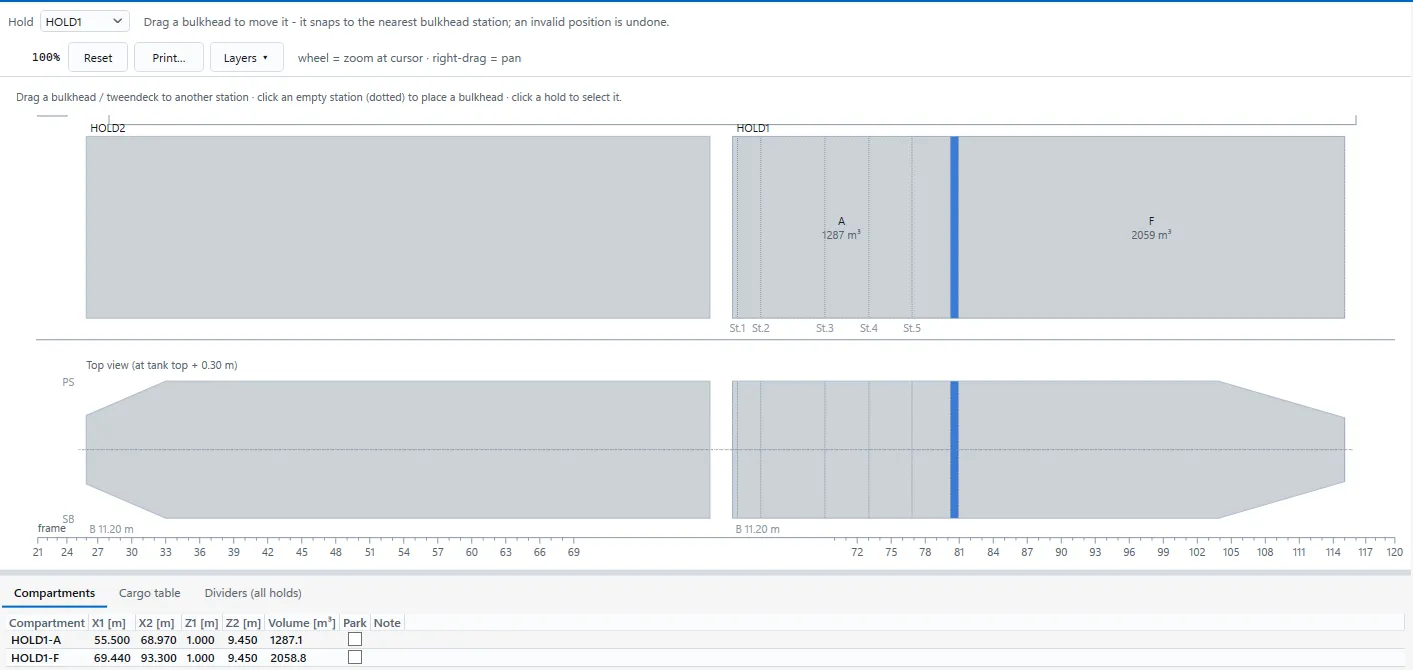
Grain separation — a hold divided by a grain bulkhead, in side view and top view, with the compartment volumes
Grain

Grain in bulk & divided holds

The full International Grain Code calculation, as amended by MSC.552(108) — trimmed, untrimmed, partially untrimmed and secured stows, each with its own volumetric heeling moment — and the grain form printed for the authorities. Holds divided by a grain bulkhead are drawn in side and top view from the 3D model: drag the bulkhead to another station and each compartment gets its own volume, load and heeling moment.

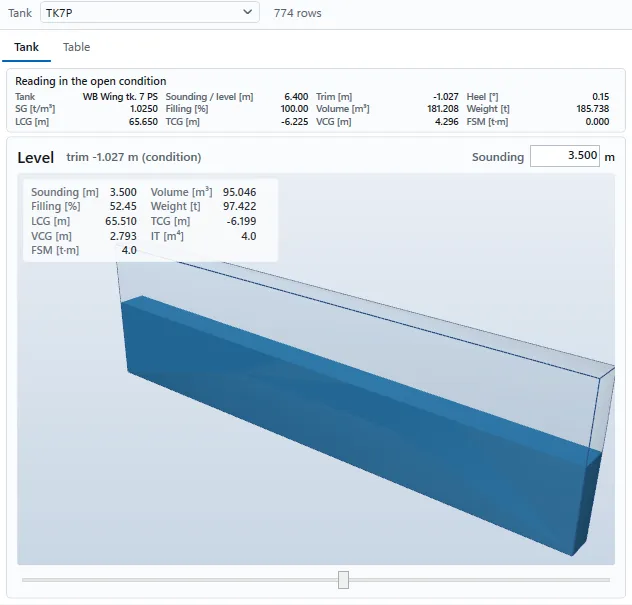
Tank calibration — a wing tank in 3D with the liquid surface at 3.5 m sounding and its volume, weight and centres
Tools

Tank calibration

Calibration tables produced from the ship’s own 3D geometry, for sounding pipe or remote sensor. The Tank page shows the tank body with the liquid surface at the condition’s trim: move the sounding and read volume, weight, centres and free surface moment at once.

Lashing / cargo securing

IMO CSS Code Annex 13 balances — transverse sliding, tipping, longitudinal sliding — for every deck cargo unit, with a separate signed securing calculation.

Draft survey

Cargo quantity from the drafts at the marks: perpendicular and hog / sag corrections, trim and density corrections, deductibles and the ship’s constant.

Protected ship data

The approved ship data is encrypted and its file list signed. The program opens only signed data on a registered computer, so the figures class approved cannot be altered on board.

Onboard manual

A searchable manual is part of the program — opened with F1, every topic printable on board, with its revision history kept with the ship database.

Approvals

Approved by eight classification societies.

ShipLCOM installations are classified under IACS UR L5 — up to Type 3, with damage stability by direct calculation. Every installation is ship-specific: hydrostatics, cross curves, tank calibration, limit curves and strength limits are taken from the vessel's approved documentation, delivered with test conditions and the class approval certificate.

ABS
BV
DNV
KR
LR
NK
RINA
TL

The regulations behind it

  • SOLAS II-1 Reg. 5 / 5-1 — stability information the master can use
  • SOLAS XII Reg. 11 — loading instrument for bulk carriers of 150 m and upwards
  • 2008 IS Code (MSC.267(85)) — the intact stability criteria
  • International Grain Code (MSC.23(59), as amended by MSC.552(108)) — grain heeling moments and criteria
  • Load Line 1966 / 1988 Protocol — freeboard and seasonal zones — the Overload Check
  • IMO CSS Code Annex 13 — securing of non-standardised cargo
  • IACS UR L5, S11, S17 — onboard stability computers, hull girder limits, flooded-hold strength

Need a loading instrument or loadmaster for your vessel?

Send the vessel particulars — we'll build the installation on the ship's approved data and support the class approval, including the Ship Data, Test Case and Addendum Intact Stability booklets.

Get a quote