Grain stability
Grain stability booklets to the amended Grain Code.
New grain stability booklets — grain loading manuals — and addenda to MSC.552(108), calculated in NAPA, prepared for class approval and loaded into the ship’s loading instrument.
- MSC.552(108)
- In force 1 Jan 2026
- Calculated in NAPA
- Prepared for class approval
What changed
MSC.552(108) in short.
Amended Grain Code
Resolution MSC.552(108) amends Part A and Part B of the International Code for the Safe Carriage of Grain in Bulk, in force from 1 January 2026.
A new loading condition
A specially suitable compartment, partly filled in way of the hatch opening with its ends untrimmed, now has its own assumed grain shift and heeling moment.
New tables
The maximum allowable grain heeling moments change with it, so the booklet tables and the loading instrument limits are calculated again.
From a recent addendum
The new condition, hold by hold.
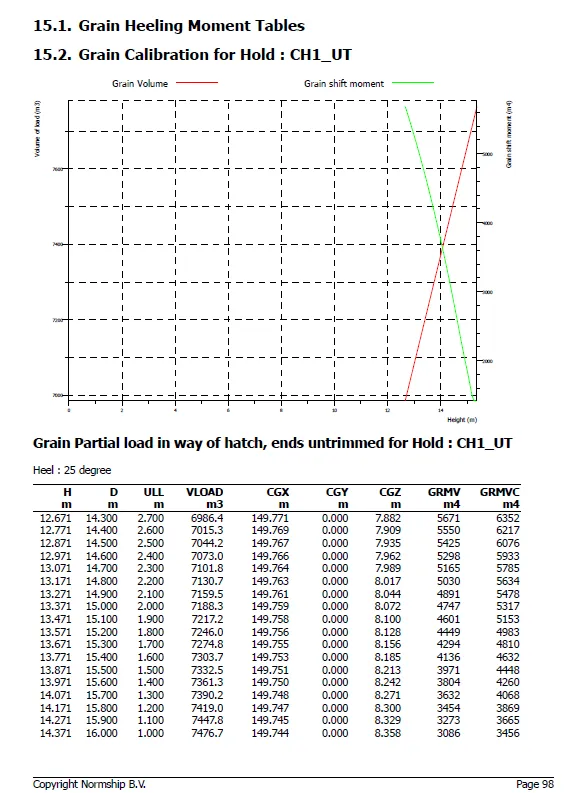
A page from a grain addendum to MSC.552(108): grain calibration for one hold and the heeling moments for the new condition — partly filled in way of the hatch, ends untrimmed. Volume, centre of gravity and grain heeling moment at each ullage, ready for the booklet tables and the loading instrument.
What we deliver
From the hold model to the approved booklet.
Grain heeling moments per hold
Filled trimmed, filled untrimmed, partly filled and partly filled with ends untrimmed — calculated in NAPA from a 3D model of each hold, hatch coamings and girders included.
Allowable heeling moments
Maximum allowable grain heeling moments against draught and KG, checked against the Code criteria: heel 12° or less, residual area at least 0.075 m·rad, GM at least 0.30 m.
Booklet or addendum
A new grain stability booklet, or an addendum to the approved one, with loading conditions, worked examples and the master’s instructions — laid out for class review.
Loading instrument
The new grain tables put into ShipLCOM, or handed over in the format of the ship’s existing loading instrument, and checked against the booklet conditions.
Questions
Grain stability, asked often.
Does my ship need a new grain stability booklet?
The amended Code, MSC.552(108), entered into force on 1 January 2026. An existing ship may keep loading in the conditions already in its approved booklet, but it can only use the new condition — a compartment partly filled in way of the hatch with its ends untrimmed — once the heeling moments for that condition are in an approved booklet. That usually means a grain addendum, with the loading instrument updated to match.
When should an existing ship be brought up to date?
When the operator wants to load in the new condition, and at any booklet revision — a draft increase, a lightweight change, or a request from owner, charterer or flag. What class and flag require for the specific ship is checked before we start.
What do you need from us?
The approved grain and intact stability booklets, the general arrangement and capacity plan, hold and hatch coaming drawings, and the lightweight. An existing NAPA model shortens the work.
Which class societies have approved your grain booklets?
Recent grain addenda to the amended Code have been approved by ABS and Lloyd’s Register.
Is it part of a draft increase?
Yes. Every draft increase needs the grain tables at the new draughts, so the grain addendum is delivered with the freeboard and stability package.
A grain booklet to revise?
Send the ship’s particulars and the approved booklet — we reply with the scope and a quote.