Draft & deadweight increase
Can your vessel carry more deadweight?
More draught means more deadweight from the same hull. We take a draft increase from the first feasibility figure to class approval. The quick check below gives an initial direction only — the result depends on freeboard, stability, strength, openings and class and flag requirements.
- Freeboard
- Stability
- Longitudinal strength
- Openings
- Class & flag approval
Need the full picture? Send the vessel particulars and we'll outline a clear, class-ready route. Get a quote →
The route to approval
Everything a draft increase needs, in one package.
1 · Feasibility
How much draught the ship can gain and what it gives in deadweight — freeboard type, keel date and ICLL 1966 or 1988, scantling draught, bow height, stability and hold loads — before engineering starts.
2 · Freeboard
The load line calculation for Type B, B-60 or B-100, with the ICLL Regulation 27 damage stability a reduced freeboard needs, the openings it affects and the new marks.
3 · Stability
Addenda to the intact stability and loading manual and the grain stability booklet to MSC.552(108) at the new draughts, and damage stability under the SOLAS regime that applies to the ship.
4 · Strength
Longitudinal strength, hold mass curves and, for bulk carriers, one-hold flooding under SOLAS XII and IACS S17 — and what a draught above the scantling draught requires.
5 · Figures and certificates
EEXI, net tonnage and equipment number at the new draught, so every certificate that depends on it is ready to be reissued.
6 · Class and loading instrument
One package to class with a covering letter, comments answered until approval, and the loading instrument updated to the new limits.
Recent work
Five sister bulk carriers, 8,560 tonnes more.
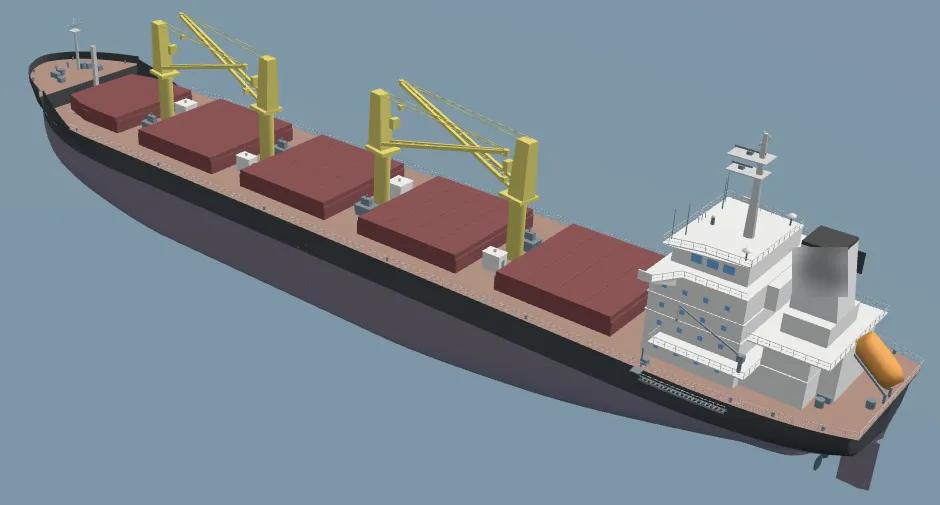
Five 35,000 dwt sister bulk carriers — four classed with ABS, one with Lloyd’s Register. A Type B-60 freeboard raises the summer draught from 10.304 m to 10.640 m, about 1,710 tonnes more deadweight per ship, with the hull unchanged. Sent for class approval in November 2026, together with the grain stability addenda to MSC.552(108).
Questions
Draft increase, asked often.
How much deadweight can be gained?
Roughly the draught gained times the tonnes per centimetre immersion. On a 35,000 dwt bulk carrier, 336 mm more summer draught gave about 1,710 tonnes. The preliminary check above gives a first direction; the feasibility study gives the figure.
Does the ship need structural modification?
Often not, when the new draught stays within the scantling draught. A reduced freeboard can require changes to openings such as air pipes or ventilators; a draught above the scantling draught needs the strength shown.
Which documents does class receive?
Freeboard calculation, stability and grain addenda (MSC.552(108)), damage stability, strength and hold mass curves, EEXI, tonnage and equipment number — each with its own document number, submitted together.
Does the loading instrument change?
Yes — new draught limits, grain tables and allowable values. We update ShipLCOM or prepare the data for the ship’s existing loading instrument.