NAPA stability calculations
NAPA, run by macros and checked at every step.
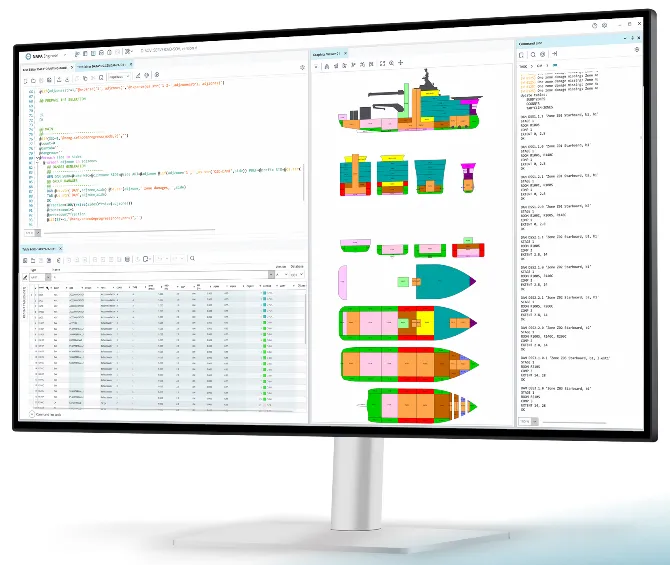
Normship is an official NAPA user. We do our hydrostatic, stability and booklet work in NAPA, the design and calculation platform trusted by naval architects and class — and we drive it with advanced macros, so the work runs fully automated and checked.
- Macro-driven
- Hydrostatics
- Intact, grain & damage stability
- Booklets
 Official NAPA User
What we do in NAPA
One 3D model, every calculation.
Hull form and 3D model
Hull surfaces faired and checked in NAPA, rooms, tanks and holds modelled once and reused for every calculation that follows.
Hydrostatics and calibration
Hydrostatic tables, cross curves, tank and hold calibration, sounding and ullage tables — straight from the same 3D model.
Intact and grain stability
Loading conditions against the 2008 IS Code, grain heeling moments to the amended Grain Code, MSC.552(108), and allowable moment tables.
Damage stability
Deterministic and probabilistic damage stability under the SOLAS regime that applies to the ship, ICLL Reg. 27 for a reduced freeboard.
Booklets and addenda
Trim and stability booklets, grain booklets, damage control plans and addenda — laid out for class review, revised on comments.
Loading instrument data
Tables and limits for ShipLCOM or for the ship’s existing loading instrument, checked against the booklet conditions.
Automated and controlled
Advanced macros, from model to booklet.
We don’t click through NAPA by hand. The whole chain runs on our own macro library — fully automated, and controlled by checks built into every step.
Macro-driven
Advanced NAPA macros run the chain from the 3D model to the finished booklet — definitions, calculations, tables and documents — without manual steps in between.
Checked at every step
Each run checks itself: the model against the drawings, the results against the approved booklet and the criteria, with every difference reported.
Repeatable
A new draught, a lightweight change or a class comment means running the chain again, not repeating the work by hand — the same inputs give the same booklet.
Traceable
Inputs, settings and results stay together, so every figure in a booklet can be traced back to the model and the rule behind it.
Hull form
A fair surface before any number.
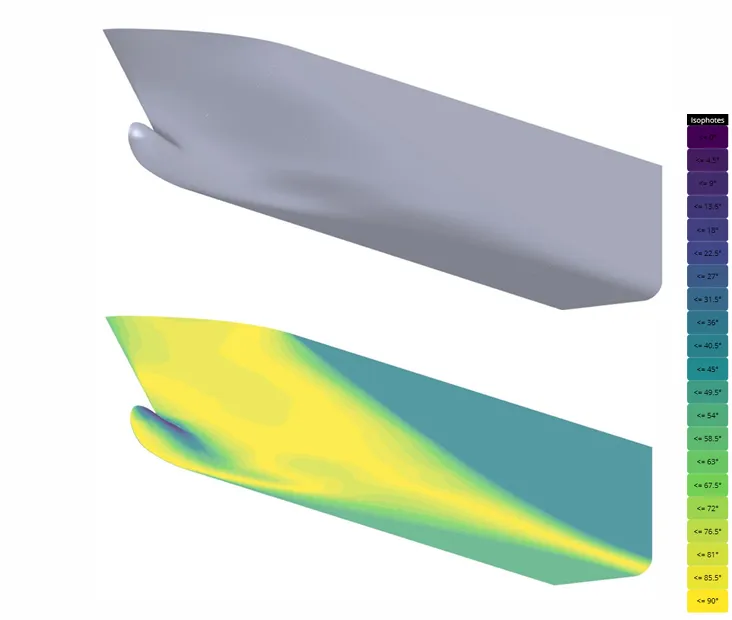
Every calculation starts from the hull surface. Isophote analysis shows the smallest unfairness in the bow and bulb before hydrostatics, stability or resistance work begins — the model is right once, and every result built on it follows.
Questions
NAPA work, asked often.
Is Normship a NAPA user?
Yes. Normship is an official NAPA user and does its hydrostatic, stability and booklet work in NAPA.
What does macro automation change for the client?
Faster revisions and fewer errors. When a draught, a lightweight or a class comment changes, the calculation chain is run again and checked automatically, so the revised booklet follows quickly and consistently.
Can you work from an existing NAPA model?
Yes. An existing model is checked against the drawings and the approved booklet first, then used for the new work. Without one, we build it from the lines plan, the general arrangement and the capacity plan.
Which calculations do you deliver from NAPA?
Hydrostatics, cross curves, tank calibration, intact stability, grain stability to MSC.552(108), damage stability, freeboard support, booklets and loading instrument data.
A booklet, a draft study, a NAPA model?
Send the ship’s particulars and what you need — we reply with the scope and a quote.